

Biological Systems Engineering
Biological systems engineering is the intersection between engineering and sustainability
Biological systems engineering (BSE) is an ABET-accredited engineering program that applies engineering principles to natural systems and machinery design that impact production of food, water, energy, and other essential human needs.
As a Biological Systems Engineering major you will:
- Explore core concepts in the physical sciences and engineering while learning skills in fabrication, electronics, design, product development, and management
- Follow defined tracks in ecological and environmental engineering, food and bioprocess engineering, machinery systems engineering, or take a broader approach with the general option
- Understand engineering using both technology and biology and consider solutions that meet the needs of the environment and public health, safety, and welfare
Career Paths
Biological systems engineering graduates are prepared for careers developing new products, processes, and systems to protect soil, air, and water quality while meeting demands for food, materials, and energy.
Here are just a few examples of what our biological systems engineering graduates are doing with their careers:
What CALS alumni do:
Agricultural Engineer
Process Engineer
Production Engineer
Project Engineer
Product Design Engineer
Research Assistant
Where CALS alumni work:
Wisconsin Department of Natural Resources
USDA Natural Resources Conservation Service
WEC Energy Group
Zap Energy
Focus on Energy
What CALS alumni do:
Project Engineer
Design Engineer
Mechanical Engineer
Application Engineer
Product Design Engineer
Production Engineer
Manufacturing Engineer
Where CALS alumni work:
John Deere
CNH Industrial
Kimley-Horn
MacDon Industries
J.H. Findorff & Son Inc.
Milwaukee Tool
Komatsu Mining Corp.
What CALS alumni do:
Agricultural Engineer
Civil Engineer
Environmental Engineer
Water Resources Engineer
Researcher
Where CALS alumni work:
Wisconsin Department of Natural Resources
USDA Natural Resources Conservation Service
WEC Energy Group
Strand Associates
Stantec
What CALS alumni do:
Agricultural Engineer
Process Engineer
Production Engineer
Project Engineer
Application Engineer
Product Design Engineer
Where CALS alumni work:
Seneca Foods
Ardent Mills
Mars
Cargill
Conagra Brands
Nestlé
Your CALS Experience
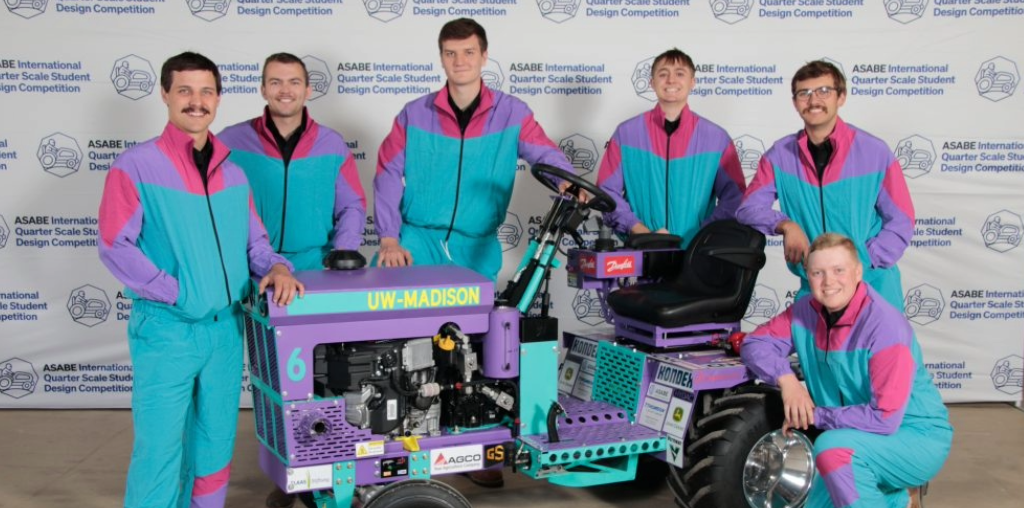
Join a competitive design team
Build a small-scale tractor and put it to the test against other national and international university teams with the Quarter-Scale Tractor Team, or brainstorm a fully autonomous robot solution to a common agricultural process in the Robotics Student Design Competition. These two competitive teams are hosted by the Department of Biological Systems Engineering.
Other engineering design competitions are found on campus, including:

Customize your path
You’ll take core engineering courses and then choose which focus area you’d like to specialize in.
- Food and bioprocess engineering: where you’ll learn to develop and manage systems that process and distribute food and other biologically based materials.
- Machinery systems engineering: you’ll be trained to design machines for production agriculture and construction.
- Ecological and environmental engineering: you’ll work with natural resources, including water, soil, plants, and air to create solutions for a better environment.
- General program: for students who are interested in a combination of the specialization areas. Some examples include aquaculture engineering, forest engineering, and biomaterials engineering.
100%
Students who participate in workplace based experience
74%
Students who complete an internship
100%
Seniors who complete a capstone experience
Advisor & Contact Information
Advisors can answer your questions, help you create a degree plan that meets your personal and professional goals, and connect you to resources across the UW–Madison campus.
Incoming students should reach out to CALS Academic Affairs to direct your questions. Current UW–Madison students should schedule with their assigned advisor using Starfish.
CALS Academic Affairs
116 Agricultural Hall
1450 Linden Dr., Madison, WI 53706
academicaffairs@cals.wisc.edu
(608) 262-3003
Biological Systems Engineering
115 Agricultural Engineering Building
460 Henry Mall, Madison, WI 53706
bse@wisc.edu
(608) 262-3310
